If you are considering Concordia alongside a major university, please consider the following:
Especially if you've already auditioned at a major university, there are some obvious differences between the big music departments and Concordia. I'd like to take this opportunity to explain some not-so-obvious things that hopefully make Concordia a strong alternative.
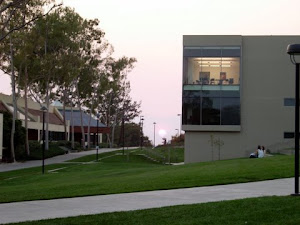
School size: Concordia is a small school. If you would like to have a significant music education but don't want to be swallowed up in a "factory" of music students, Concordia is the place for you. If you want to be able to take a short walk to the music building to practice in the middle of the day, that is no problem. Our campus is small and and the music buildings are accessible, which is not the case at many major universities. Of course this means that you won't be competing against dozens of motivated musicians on your instrument. In most cases, you'll be one of a few music majors on your instrument. If you are the type of student that has intrinsic motivation, the lack of massive competition won't keep you from being a high achiever. And the close-knit nucleus of music majors who have similar goals as you will become your best friends as you share many experiences.
Becoming a seasoned performer: The flip side of our small size is that you will have numerous high-pressure performance opportunities. You'll be able to compete for the principal chair as a freshman (if you are a particularly strong player) and you won't have to beat out a whole studio of graduate students to get it. Even if you are not the principal player in your section in the Concordia Wind Orchestra, our policy of not doubling parts unless it is necessary for balance (mainly in the clarinet section) means that you will have a playing experience more like what is common in a symphony orchestra - you'll be singularly responsible for your part. The result is freedom to phrase and express your part and make decisions about how to do this. Therefore, you'll be expected to think and execute a high level of musicianship and your part will be very exposed - each performance is high stakes! And
our repertoire is advanced college music.
At Concordia, you will become a very seasoned performer. The Concordia Wind Orchestra performs nearly 30 times per year, its associated chamber ensembles perform anywhere from 2-15 times per year. Also, as a soloist you will be expected to perform a piece in a noon recital twice per semester. Students who achieve the 300 level in applied study by their sophomore year are eligible to present a half recital (app. 30 minutes). Juniors give a half recital and seniors give a full recital. And our music department's close association with worship provides an additional layer of performing for soloists and chamber groups. If you want to become a great performer, you'll have plenty of practice at Concordia!
Private Study: Concordia is located in one of the most musician-dense populations in the entire world. When a position becomes available, we have an unbelievable pool of talented candidates. Concordia's teachers are some of the finest in Southern California. Their resumes attest to that (you can read them at www.cuimusic.com/privatestudy.html).
Instrument Access: If you are an instrumentalist that needs access to more than your own instrument, we can accommodate. Percussionists can view our extensive list of outstanding instruments, including a Musser 5-octave marimba at www.cuimusic.com. Trumpet players can check out a C trumpet, piccolo trumpet, D/Eb trumpet, or a flugelhorn. Clarinetists can check out an Eb clarinet, bass clarinet, alto clarinet, or an A clarinet. And we have a new contrabassoon for bassoonists. And all of these instruments are less than 4 years old, and they are top-of-the-line professional models. There are not many schools our size that can boast such a collection of instruments.
Degree: Concordia offers a Bachelor of Arts in music. One of the emphases that you can select is performance. We don't offer a Bachelor of Music degree, which requires more units than a Bachelor of Arts (although many music majors far exceed the number of required music units to graduate). However, a Bachelor of Arts degree fully educates you. Sometimes students are nervous about majoring in music because they are afraid that they are locking themselves into a particular career path. Not so with a bachelor of arts. You will develop your non-musical skills fully - the skills of communication, writing, and thinking. Make no mistake about it, these skills help you stand out in a very competitive fields.
Faith-centered Music: And finally, the most significant thing that makes Concordia distinctive against major universities - Christian ministry. We hear a lot about spiritual connections with music, but at Concordia music affords a spiritual connection with the Lord. Many concerts take sacred themes, and most of our groups perform regularly in worship.
If you want to play music at a high level in a uniquely faith-based way, please consider Concordia. Our facilities may not be as spectacular, but the Concordia Experience more than makes up for this.